
The chief metric Frederick Law Olmsted used to judge a park was the quality of the walk it could provide a future visitor.
An ideal walk was in an a natural setting where visitors felt transported away from the busy, commercial world. The more they felt like they were in a wilderness, the better. Equal accessibility was key—everyone needed to feel welcome. Prioritizing the pedestrian required an absence of all speeding traffic and a preponderance of peace and quiet. Trees, lawns, streams, and other people were the only kinds of distractions Olmsted wanted visitors to encounter.
Above all, though, a successful walk required a sense of total freedom.
Whether visiting a park once, or everyday, Olmsted wanted you to feel overwhelmed with enticing options, forcing you to select your own path. A slight risk of getting a little lost was a good thing; he liked to keep signage on the light side. He wanted you wondering where that set of stairs led to, or how to get on the path that crossed over that bridge you were walking under.
Ensuring everyone felt utterly free wasn’t just a park perk, it was the entire point.
Each walk was meant to accomplish two objectives. To help individuals heal, he wanted to connect city dwellers to natural settings. But in these landscaped wildernesses, to help society heal, he also sought to connect strangers with one another. After surviving the Civil War, the nation was still rife with divisions and animosity. Unless space was provided and protected where the public could spend time together and get to know each other, he feared the union would fall apart again, this time for good. The key ingredient to any park was and is a multitude of visitors arriving from all directions and backgrounds eager to share the space and spend time together, treating each other as equals.
When asked to design a park for a city, the prospective clients often had a site already chosen for Frederick Law Olmsted to consider.
He walked the grounds to determine whether it would make the grade and meet his two objectives. If it seemed to him the land had few charms and might be unwanted property looking for a purpose, he might question the city’s motives. It wasn’t uncommon for him to find that prospective client cities hoped the unwanted land designated as a “park” could answer multiple needs—a green that connected a future library, theater, war memorial, and city hall, for instance. Olmsted often declined such projects outright. He might suggest another location in the city that better suited his goals, but these possibilities often meant buying private farms and estates. Sometimes, the clients reconsidered, but many times not.
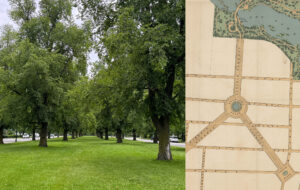
Every park Olmsted ever worked on is over a century old now.
All have been transformed by successive generations of stewards. Neglected or maintained, most parks continue to work much as Olmsted intended. They remain retreats where anyone can defy the built world and find a moment of peace with complete strangers. Their key components are still functioning as they should. (In much greater detail, I spell out the democratic components to his parks in my essay, “How Olmsted parks work,” that appears in my book Fairsted by Levellers Press.)
I thought I’d recognized all the major ingredients, until I visited the two Olmsted parks in Bridgeport, CT last year. After driving hours to get there, greeting me at the entrances of each park were signs telling me a day pass for non-Connecticut residents would cost $100.
This was a new experience to me. I’d never felt infuriated in an Olmsted park before, and I was surprised to find a key critical element I’d overlooked. To be clear, public parks must be free to enter.
It doesn’t matter how many democratic components are in place in your park, if you’re charging admission—especially to target a select demographic—your park is not “public.” Private parks can appear identical to public parks in every detail, but they simply don’t produce the same results. If you’ve added a filter on who gets to go inside, you’ve removed the secret sauce that makes public parks democratic experiences.
To be fair, you can walk into Bridgeport’s parks without paying a dime. The fee is for cars, and it’s only collected between Memorial Day and Labor Day. But there is little parking outside the parks, and the decision to add a tollbooth has warped and distorted how the parks are accessed and enjoyed, no matter the season.
Instead of being welcomed through a variety of gates, Bridgeport has whittled the number of entrances to one per park. Instead of a network of paths allowing you to have a different trip each time, Beardsley Park sets pedestrians and cars on a linear path. Once a car enters that park, it cannot backtrack, but must drive through the park to the single car exit. Pedestrians aren’t provided a viable second exit; they’re meant to go out the way they came in. This is made far worse for both walkers and drivers, since the zoo’s intrusion forces all visitors to travel for nearly half a mile along barbed wire fencing to reach the park.
Bridgeport’s Olmsted parks—Beardsley and Seaside—are well maintained, have clean bathrooms, and are clearly well used and loved by their visitors. Each is rich with history and enjoys unique features and vistas. The parks ought to be on every New England visitor’s itinerary, but Bridgeport has chosen to prioritize car traffic in their parks and planted tollbooths at the gates to ward off out-of-towners who might be foolish enough to want to visit.
By Olmsted’s scale of what makes a quality park, the city by the seaside that claims the title “Park City” has some work to do.
*
After years of living in New York City, Olmsted moved his home and office to Brookline, Massachusetts, just outside of Boston. The last decade of his life was spent building the Emerald Necklace, the park system that runs through the state’s capital city. Part of the Necklace ran along the border with Brookline and was a short walk from his house.
Olmsted was sometimes asked why Brookline didn’t have a park? He and his firm designed the landscapes for many of the town’s estates, but never a park. Why not? To the park builder, the reason was clear and simple. Brookline already had tree-lined sidewalks, curving paths, a picturesque reservoir, and many small green spaces. The houses were often situated in such a way as to let the forested rolling hills dominate. His chosen hometown currently provided its residents a suitable environment for a good walk and an ideal setting to meet their neighbors.
Olmsted preferred to use his talents where they were needed most—busting up the relentless street grids of the nation’s quickly growing cities, and in their place, introducing trees, lawns, and ponds for everyone. For free.
Related