Yes, a lot has changed since the Olmsteds did some of their best work for the city of Bridgeport.
Looking at current day aerial photography and comparing that with Olmsted’s plans, it’s easy to think that the highway running along one side of the reservoir was the biggest threat to enjoying Beardsley Park. The eight-lanes of high speed traffic on Route 8 is undeniably a major intrusion (and bummer), and it’s no delight to spot the orange lettering of the Home Depot across the water while you’re birdwatching. Still, there is much to enjoy in Beardsley Park. Clearly, a lot of people love the place dearly—a number of them told me so themselves.
In my four visits to Beardsley Park in the last year, I’ve found that many parts still retain the Olmsted glory, but as a whole, something has gone amiss. The way the park was meant to work has been broken. I think I have a good idea what the issues are and how they could be addressed, but first, let’s review some of the park’s features.
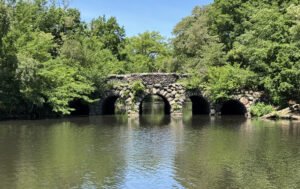
The interplay of meadow, forest, and water is very much alive in much of the park. At the southern entrance, there’s a tremendous stretch of lawn overlooking the pond. That’s hard to miss, and it’s usually covered in geese. Less obvious is a bridge leading to a perfect fishing island on the southern most part of the shoreline. Locally, it’s known as “Lover’s Island” and the bridge is known as the Henry Setzer Memorial Bridge.
Midway through the park, the pond ends and the river begins. Here, there are many places where people have made stone dams and enjoyed playing in the shallow water. The forest gets thicker here, and in the summer, you can hear the highway traffic only faintly. The river continues all the way north on the western side of the park, under the overpasses, splashing over the waterfall and continuing into the woods beyond the park. It’s a really nice walk.
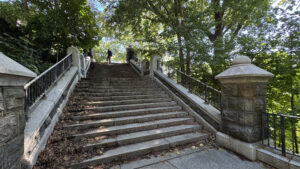
On the eastern side of the park, though, nearest the adjacent neighborhoods, all the foot paths have disappeared. Vast tracts of parkland appear to be wholly unused. Aerial photography told me there was a tree-lined avenue in the park leading to a bridge, but when I got to that area, the avenue was no longer paved. There wasn’t even much of a foot path. Just a grassy patch that ran through the trees. There were no signs prohibiting me, but also nothing encouraging me. As I headed along the unused road with my camera and tripod, I felt like I was leaving the park behind.
The first time I came to the tree-lined stretch of road with the bridge beyond, two police cruisers were parked there enjoying the solitude. Next to one another, the officers were chatting until I showed up. As I approached, one car took off, driving across the grass and jumping the curb. The other officer rolled slowly towards me, his window down.
“I’ve worked here my whole life,” the policeman said when I explained what I was doing, “but I had no idea the same guy who designed Central Park did this park, too. Who would of thunk it, right? But I’ll tell you: we rarely have any problems with people in this park. They love it. People come here, and their blood pressure drops, you know?”
He drove away, too, and left me to investigate the bridge. I quickly discovered why the road was no longer used. Across the bridge stands a chainlink fence topped in barbed wire. Just beyond is the Beardsley Zoo.
*
The zoo was introduced in the 1920. It took over the hill at the southern end of the park and a number of the park buildings that were there. Roughly, the zoo eats into a third of the park’s acreage, but instead of nibbling at either end, the zoo effectively bisects the park. To get from the park’s only entrance in the south, there’s a narrow gauntlet of several hundred yards that runs between barbed wire and the pond.
To make matters considerably worse, instead of the nine entrances planned by Olmsted to maximize access—and which could be used to either exit or enter—all options have been eliminated. There is one designated way for everyone to enter the park, and elsewhere there’s an exit just for vehicles. Instead of a network of footpaths, there is one, linear path that runs the length of the the park. All possible footpaths from the neighborhood lining the eastern side of the park have been eliminated, and for long stretches, there isn’t even a sidewalk.
Adding insult to injury, the city of Bridgeport charges $100 for out-of-state cars visiting the park between Memorial Day and Labor Day, channeling them along this one way route past ballparks and playgrounds. If you want to see the water, you need to stop and park, but there’s few convenient places to do that.
Last year, I wrote an essay called, “How Olmsted Parks Work” which appears in my book, Fairsted. In the essay, I outlined the components that made Olmsted parks uniquely democratic—places that promoted diverse strangers enjoying each other’s company. I thought my list covered everything, but Bridgeport reminds me that sometimes what’s obvious to one person is completely lost on an entire city.
For a public park to work, it must be free to everyone.
Putting a tollbooth outside a public park makes it no longer public. Any limit or filter as to who can visit undermines the central, welcoming purpose of the park’s existence. Blocking some people suffocates a park and makes it less effective for those who are able visit. I made this point when discussing Seaside Park, but again, I will hold off on a full discussion until a later essay.
Even if the fee were lifted, though, the greater obstacle to the park working as it should is the preference given to vehicles over pedestrians. Parks are meant to be an escape from traffic and a haven for walkers, not the reverse. In Beardsley Park roads now cover far more area than the single walking path does, and the roads often don’t include sidewalks. While there are some lovely fields and an island in the southern portion of the park, it’s a half mile walk from the park’s entrance to the main body of the park. Much of that half mile walk is along barbed wire-topped fencing. What if you get to the other side and decide it’s not for you? Why, it’s a half-mile walk back to the park’s only clear entrance!
A key component of all Olmsted parks are branching, curving footpaths that offer a sense of freedom by the options they offer. To Olmsted, a park needed to be able to offer someone a good, long walk in nature, with plenty of choices of where to go and opportunities to meet other people. Roadways were deliberately kept hidden and discrete, whereas paths appeared to run amok. With so many options to choose from, it was easy to get lost (a desirable feature to Olmsted) and have a different walk every time you returned.
By prioritizing traffic and limiting the ways to enter the park, Beardsley Park eliminates much of this sense of freedom with its single, linear path across the park. Large tracts of land in the park appear unused and empty because no path goes there. There’s no where to park nearby these places. The single path also means every other pedestrian is either coming or going along it; instead of happening upon someone, you can see them coming from a long way off. I had a few conversations with folks, but mostly it was a polite nod as we passed one another.
*
As with Seaside Park, there is little in Beardsley Park to suggest America’s premier park design firm had anything to do with it. Indeed, after four visits, I didn’t see Olmsted’s name anywhere. But just as I was in my car, heading out of town on my last trip there, I spotted a statue out of the corner of my eye at the edge of the park. I pulled into the nearby neighborhood and parked. There were no sidewalks here, either. East Main Street is busy, and even with a clearly marked crosswalk, no one slowed for me. I had to wait until there were no cars to cross and examine the statue.
It was a bust of Olmsted as he looked in his youth, decades before he worked on Beardsley Park. It had two plaques on the pedestal. One explained something about who he was and the other was about how the park came to be.
I was delighted to see the recognition, but after four days of looking for something like this, I had to wonder at the memorial’s placement. No path or road goes to the statue. It’s alone in an empty field, and the bronze face looks out at a busy road and houses beyond. Maybe that’s for the best though: I don’t think he’d like looking out on what has become of Beardsley Park.
Photography by Mark Roessler
Historic plans courtesy of the Olmsted National Historic Site.