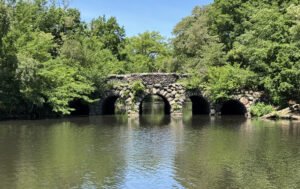
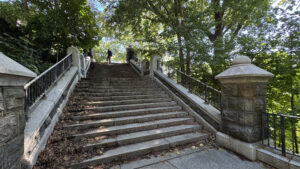
Seaside Park in Bridgeport, Connecticut was the first park designed by Frederick Law Olmsted and Calvert Vaux outside of New York and Brooklyn. In the wide and varied portfolio of Olmsted parks, it stands out. Its chief distinction is that no other park is built with ocean frontage, but there are other ways it diverges from the norm that are less romantic.
P.T. Barnum, the renowned showman, circus genius, state congressional representative, and future mayor wanted the people of his adopted hometown to have access to the sea. The busy port city was full of industry and shipping activity, but there was nowhere people could wade in the sea, or walk along the shoreline. Barnum wooed the newly formed landscape architecture firm to consider building a lavish public park along the Bridgeport Harbor and Long Island Sound. They submitted their plan in 1867, the same year they provided plans to Brooklyn for Fort Greene Park.
Today, Seaside Park offers an abundance of seaside access. The trees along the paths have grown large, but the low branches are trimmed to a unified height. This offers a clean view in all directions and allows for the sea breezes to sweep through the park. The part designed by Olmsted and Vaux is to the east. The original park was only 35 acres, but over the next century it grew to 375 acres, extending along the shore to the west. From my few visits to the park in the summer of 2025, it seemed the older parts of the park were the best used, and this is where I photographed.
Despite the ample lawn and groves of shade trees, the promenade along the water is still the park’s defining feature. Sweeping from the harbor, past the breakwater, and along the Long Island Sound, the path runs parallel with a low seawall that is only partly fenced. The ferry passes at regular intervals, and there are triangles of white sail out on the Sound. Whether it’s blustery out or you stroll beneath skies of dazzling blue, Seaside offers a satisfying slice of nautical joy.
Away from the promenade, though, along the wooded paths and carriage roads, modifications and redesigns have made the pleasures of the park more elusive. Ground crews keep the lawns trim and the trees clipped, but the landscape no longer feels very park-like. Fenced baseball fields dominate the biggest patches of meadow. Further—and far more alarmingly—traffic choices by the city have sabotaged the park and essentially broken how key components were designed to work.
The majority of Olmsted’s plans and letters have been archived and are available to review. Even a single early plan can explain a lot about the designer’s intentions, and what future compromises or enhancements might have been. Unfortunately, many of the plans and preliminary work for Olmsted and Vaux’s earliest projects were lost in a fire at Vaux’s house.
None of the 1867 plans of Seaside Park appear to exist, though it does figure in several early maps of the city. Each map shows much of the park’s path system that is there now. When first built, the designers intended the entrance of the park to be at the eastern end, between Broad Street and Main Street. There, a wide carriage road was flanked by two paths and rows of trees. This route curves gently, presenting the sea with a sweeping gesture. It’s a grand entrance.
Before Olmsted and Vaux were employed, construction of a large Civil War monument had been started near the center of the park. If you weren’t going to ride along the ocean, that was your other landmark to visit. Trees and lawns took up much of the land nearest the harbor, but to the west, a large oval racetrack dominates the park. Horses were raced there for decades, until cars took over. These days, thankfully, racing is done. The grass oval has a bandshell, and one of the days when I was visiting, it hosted a festival and was full of tents and music.
Olmsted was never a fan of including memorials in his parks; he thought they interfered with the natural setting he was trying to create. The racetrack, though, seems utterly at odds with the idea of passive recreation that he was trying to encourage. As his fame grew, Olmsted was able to refuse work that contradicted his principles, but my guess is that the allure of working with the world-famous P.T. Barnum made the landscape architects more agreeable to whatever he proposed. It’s unfortunate. Once you leave the coastline, the interior of the park—dominated by the war monument and the racetrack—does not provide the transporting sense of his other parks.
Still, bigger, more disruptive changes were to come.
*
In 1918, the Perry Memorial Arch was donated to the city to stand at the end of Park Avenue and act as a new entrance to the park. William Perry owned a sewing machine company in the city and was the parks commissioner for a time. The arch was designed by architect Henry Bacon, who also designed the Lincoln Memorial in Washington, DC. It’s a handsome arch, but it’s imposing and completely out of character with the rest of the park.
What’s more, the park already had an elegant, tree-lined entrance that highlighted the ocean views, rather than calling needless attention to itself.
Olmsted and Vaux designed their parks to connect visitors with natural settings and to provide a common ground where they could meet as equals. In Central Park and elsewhere, they fought against overly ornate or excessively grand entrances. In those instances, they argued that ostentatious displays of wealth suggested the parks were for only select types of people. Fancy arches, like the one in Seaside, would undermine the sense of tranquility and equality the designers were trying to create with their wilderness settings.
Olmsted parks were also intended to prioritize the pedestrian experience. Carriage roads were added in such a way as to not interfere with people walking. Seaside’s original entrance works this way, offering two tree-lined paths flanking the road. The new archway, though, was built for cars. There is a discrete foot path on either side, but the arch dominates and strongly suggests the way to enjoy the park is by car.
And, if you doubt that this is the intent, consider the current-day toll booth erected at the base of the Perry Memorial Arch and the sign which lets out-of-state visitors know they can pay $100 for a day pass to drive around the park. Charging for access to a public park, as far as I’m concerned, ought to be unconstitutional, but that’s a topic I’ll discuss in a broader essay. For now, let’s discuss why Seaside Park might now cater exclusively to cars.
*
Olmsted’s parks were generally built near the downtowns of the cities where they were located. Neighborhoods grew up around them, and those communities continue to thrive today. The character of the park often influences its surroundings. Unfortunately, this hasn’t been the case with Seaside Park.
For several years, I visited Bridgeport for work on a near-monthly basis. I was as much an Olmsted fan then as I am now, but I had no idea that Seaside Park was a ten minute drive from my office. When I went back to photograph the park last year, I understood why it had been so hidden from me. The park is separated from downtown now by two elevated highways and multiple train lines. There are many husks of gorgeous Victorian buildings, but the neighborhoods on the the other side of the tracks are as rundown as you might expect. Bridgeport University is near the park now. Its pleasant campus offers both free parking and a sense you’re in the right place, but the drive to get there can feel harrowing for a country mouse like myself.
To put it another way, there’s no way I’d walk or ride my bike to Seaside Park, even if I lived only a mile away, and judging by the bulk of the people I saw there, that’s the common attitude.
More people sat in their cars—or near their cars—than occupied benches. Everywhere, people sat in their mini-vans enjoying fast food, all the windows and hatchback open, blaring music. Some preferred to enjoy the seaside from behind tinted glass, windows up in air-conditioning. These people were all literally in their own worlds; when I walked past them, I didn’t get any sense of connection whatsoever.
During the several times I visited, I only once saw a couple sitting on the grass. Some people were out, strolling on the promenade, or walking their dogs among the trees, but at no point do I recall seeing young children playing or running about freely. While no one spoke to me—a unique experience in the Olmsted parks I’ve visited so far—I got tooted at more than once by cars letting me know that I was in their way.
In so many ways, Seaside Park does not feel like an Olmsted park. Even worse, though, for those who don’t know the park’s origins, the city of Bridgeport is of little help. Most places brag about their Olmsted park with multiple plaques, lots of signage, and maybe even a statue. Bridgeport has two Olmsted parks, but neither includes any nod to their designers. Not a mention, anywhere. I haven’t seen this omission in any other Olmsted-designed property, and it’s particularly odd in a place that calls itself a “Park City.”
Related