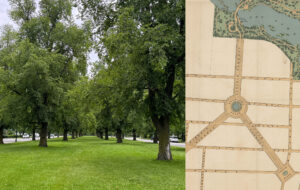
Before I explain, a clarification: Olmsted didn’t just design public parks in cities; he was also the one responsible for the concept of National Parks—wilderness preserved for public use. So, whatever kind of public park you’re discussing in America, Olmsted had well-developed and thoroughly documented thoughts about how these landscapes should be treated and used by the public.
Olmsted parks were designed to achieve two connected goals. In addition to providing people access to the wilderness—healing retreats from built up, fast paced, urban environments—Olmsted wanted to provide democratic spaces where Americans could learn to live together in a harmonious, joyful setting.
While he was adamant about his parks being open to everyone—regardless of age, gender, race, class, religion, or physical ability—Olmsted was equally certain about the types of behaviors that should be permitted and those that should not. His parks were designed to be used exclusively for passive recreation—walking, sitting, and stretching out on the grass. In other words, for parks to work as intended, he wanted to keep everyone quiet and mindful.
If they had existed in Olmsted’s time, I’m certain that he would have thought both amplified music and loud cellphone conversations as being detrimental to the park’s purpose. In addition to disturbing wildlife, loud music and conversations tend to push people away from one another. Rather than encouraging the kinds of democratic interactions he was hoping to cultivate, allowing some to selfishly pollute the quiet means no one can enjoy it.
But here’s the thing: even before he got to complaining about the loudness, Olmsted would have had a serious beef about the running itself. In Olmsted’s time, physical exercise as a pastime didn’t exist like it does today. Unless they were in a hurry to get somewhere, people in the 1800s didn’t jog or run for pleasure or for their health. The lack of cars and processed foods meant obesity was far less common, and few people had the time to devote to physical exertion as a leisure activity. Even if they were as quiet as mice, Olmsted would not be pleased to see runners turning his footpaths into racing tracks.
Regardless of what Mr. Chase thinks, paths are components to parks, not “fluid parks” themselves, and there is a right and wrong way to use them.
Sometimes in an Olmsted park, you’ll see signs which read, “No organized sports.” Olmsted believed that all kinds of athletics conflicted with this goal of providing a peaceful retreat in nature. He was certainly not opposed to sports, but he felt those types of activities should have their own venues—athletic fields and gymnasiums—not parks. Certainly, since Olmsted’s time, there have been many intrusions into his landscapes. It’s rare to find a park without ballfields, tennis courts, or some kind of exercise equipment. It’s a mistake to think, though, that he would have approved, or that everyone is in agreement that these are desirable additions.
A great deal of the effort Olmsted and Vaux spent in designing parks and laying out walking paths was about keeping pedestrians separated from horse-drawn traffic and, later, automobiles. The idea was that once you entered the park on foot, you would be safe from these intrusions. You could wander at will, as long as you didn’t disturb other’s recreation.
These days, as I photograph Olmsted parks, I tend to keep to the walking paths. It’s rare that I’m not shouted at several times: “On your left!” as some jogger or bicyclist whizzes by me. Every so often, when I’m gazing at a view or a bird, there’s a near collision as someone thunders past, thinking I’m the one in their way. A recent article in the New York Times discussed this phenomenon as it pertains to electric bikes, and the story opened with someone who had gotten knocked to the ground and sent to the hospital by a delivery guy taking a shortcut.
Like Olmsted, I don’t object to jogging or runners, per se, but they have no place on walking paths in public parks, whether or not they’re also being obnoxiously loud. It’s concerning to learn that the president of America’s Trail Running Association (and a lawyer, no less) seems to have such a tenuous grasp on the purpose of public parks or how most people enjoy them. Oh well, guess I’m just being a simp.