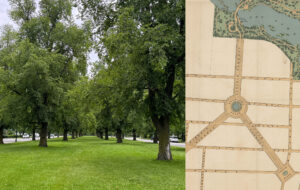
In his day, Olmsted saw that the daily lives of most Americans contained too few opportunities to see one another as equals. Whether at home, at the office, or at school, where you were permitted to go and how you were treated depended on your age, status, and income. Under these circumstances, democracy existed only in theory.
More than pretty spaces, Olmsted saw his parks as antidotes to modern life, helping undo the rifts and stresses caused by living in our world on a daily basis. Instead of ornate gardens and clipped hedgerows, he created wilderness. He built parks to be common ground where we could defy division and strengthen our sense of community. He was trying to make democracy tangible—something you could find in abundance, regardless of the season, in a park.
But where did this vision come from? Olmsted’s letters from his early years working on Central Park show brilliance and ambition, but also someone prone to confrontation, not community. He fought suggested redesigns to the park, micromanagement, the unruly public, and the police forces he employed to control them.
As I describe in my new book, Fairsted (from levellerspress.com), Central Park almost was the only park Olmsted worked on. Just years into its construction, Olmsted began threatening resignation if his superiors didn’t accept his demands. Eventually, he quit the park in anger, vowing never to return to landscape design.
He then tried working for the federal government during the war. That position lasted eighteen months, before frustration with his bosses had him looking for new work. His final attempt at employment, as the manager of a goldmine in California, was almost ruinous. All the while, his former partner, the architect Calvert Vaux, urged him to reconsider and return to New York, but Olmsted was adamant he would find success in another field.
What made Olmsted eventually change his mind about designing parks was his own recovery after spending time in the wilderness. Physically ill from years of depression, Olmsted was rejuvenated during a six week vacation with his family in Yosemite. There were still no roads to the valley at that time, and it was days on horseback to the closest town. With his wife, four children, a nanny, and a cook, they camped in the magnificent valley, bonding as a family for the first time, sometimes alongside Native American families and their children.
During this trip in 1864, Olmsted had a series of epiphanies. Not only did everyone need access to beautiful stretches of wilderness for their mental health, Olmsted believed people living in a democratic nation had a right to them. Further, he felt he was the man to bring this much needed relief. Ultimately, he built more than 40 parks across America, and his sons built hundreds more.