My wellness life-hack? I try not to watch violent thrillers, murder mysteries, or hard-hitting documentaries before bed. I don’t sleep well when I do.
This idea that what you consume can have adverse effects on how you feel is far from new. Still, so many heads are being scratched these days, wondering how America has gotten itself into its current dystopian state. Might I suggest it has something to do with all the dystopias we’ve been gorging on?
Growing up in the 1980s, I watched the post-apocalyptic genre climb out of its niche and reach impressive heights. Then it plateaued and turned into a vast, desolate plain that just goes on and on forever.
I remember when there were only a handful of zombie movies out there, and they were all actually scary and unsettling. Now, the walking dead are commonplace and even under threat as our preferred grizzly end. New contenders, like pandemics, alien invasions, and genetic tinkering are now in the running for our latest, favorite demise. Computer-generated imagery allows us to realize each snuffing in stunning detail, never before imagined. Whether in theaters or streaming, the end is nigh so often, it’s bewildering.
And there are very few alternatives on the menu. The rich, post-apocalyptic world acts as our current fantasy realm, so the opposite kind of media are reality shows, documentaries, or dramas that take place in the “real” world. For entertainment value, gritty and raw rule, and increasingly, that’s what our news stations offer us, too. Everywhere: outlook grim.
I wonder whatever happened to people dreaming up utopias? Why can’t we binge any of those? When did imagining a better future go so out of style? I know everyone hopes the current situation will end soon (whatever that may be at any given time)—and as painlessly as possible—but what’s next? Won’t “more of the same” result in the same kind of debacle we’re currently experiencing, but only worse? Anyone got any ideas?
Here’s a couple utopian visions I’ve come across that help me when the radiation levels threaten my hair will fall out, or I’m down to my last Twinkie.
When William Morris was a student in Oxford in the 1850s, he spent his time going through medieval illuminated manuscripts in the Bodleian library and delighting in the detail and artistry of the drawings and type faces. To him, this was evidence that the monks that created the gorgeous, colorful manuscripts loved what they were doing. Consequently, he concluded, they likely lived contented lives. This correlation between finding joy in your work and living happily became the central pillar of his career and philosophy.
During the Industrial Revolution, Morris watched the multitudes find work in factories producing vast quantities of low-quality products. Morris responded by designing and producing by hand, with traditional techniques, wallpaper, fabrics, and furniture—works of art that became household fixtures and internationally popular. He also wrote fantasy novels, designed the type they were printed with, printed them, and bound the books himself. Late in life, in the 1890s, he wrote his only book that imagined the future. “News from Nowhere” was a utopian vision, and it inspired generations of British readers in the following century to become socialists.
The book is about a man waking up in a future London set about 250 years from when it was written—about a century in our future—and the world is nothing like any representation of the future I’ve encountered. Instead of skyscrapers, flying cars, and more of everything, Morris envisions a smaller, more rural London with a river that’s safe to swim in. Tree-lined roads and fields connect different places of activity. People live where they want in small cottages, doing whatever work they want beautifully, thus all producing works of art. There is no money, and everything is free. Sound impossible? Morris works out the economics in far greater detail than I can here, and if not completely persuasive, it’s highly compelling. By the end of the book, you find yourself wondering, why not? If it worked, what could be better than that?
In our actual, modern world, with attention focused on ephemeral wealth (BitCoin) and artificial intelligence, we would appear to be heading in the completely opposite direction from what Morris envisioned. Though we’ve never bothered to tackle fixing poverty and hunger, we seem to want a world where value is created and managed by software, no one has anything to do—or even the ability to earn a living. Sounds like an ideal place for a zombie family to thrive.
Frederick Law Olmsted also had a utopian vision for how America could be. Unlike Morris, though, he actually had a chance to enact many of his ideas and see some of them adopted.
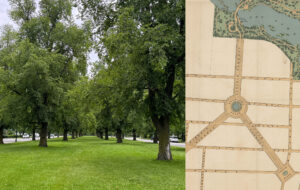
Similar to Morris, he felt that the modern industrial world made such great demands on people that it led to illness and death. After the Civil War, he and Calvert Vaux decided to work together to build public parks that would offer immediate solace to anyone suffering from the rigors of modern life. Much is made today of how a park’s natural setting can contribute to an individual’s physical and mental health. This, of course, was intended, but it’s only a fraction of what Olmsted and Vaux were trying to accomplish.
Like a cathedral, mosque, or temple is designed to amplify a group of people’s sense of the spiritual, Olmsted wanted his parks to augment Americans’ sense of democracy. In addition to connecting us with the natural world, he wanted strangers to connect with each other in a beautiful space. The more than 40 parks Olmsted designed (and those later designed by his sons) were the realization of this vision, and their continued use and existence is ample proof of their success.
In the century since Olmsted and Morris, there have been other utopian visionaries and efforts to realize a better world. During the 1960s and ‘70s there was a resurgence of interest in questioning the status quo and looking for improvements. The counter-culture experimented with varieties of communal living, and other utopian visions were debated. Gradually, though, the nation founded by radicals, has opted, instead, for something stultifyingly conservative. Imagining a better future seems almost preposterous, whereas picturing everything going to hell is pop culture.
How do we fix this?
Might I suggest that the next time you get the cataclysm itch, you head to a nearby park and imagine to yourself what the ideal world might be like. Consider what Morris had to say, and if you disagree, how could his vision be improved? Be specific. Get detailed. How would you like to spend the rest of your days? What would feel like an improvement to you?
And then, let everyone know. Let’s start talking about that for a change. Let’s binge a brighter future.