Rest in Peace, Calvert Vaux

Finding Vaux’s resting place in Montrepose Cemetery, Kingston, NY.
September 25, 2025
Calvert Vaux’s gravestone in Montrepose Cemetery, Kingston, NY.

Montrepose Cemetery sits near the top of one of the hills that surround the Hudson River town of Kingston, NY. It’s a large cemetery, but not vast. I knew that Calvert Vaux, the architect and Frederick Law Olmsted’s first partner, was buried here with his wife. I had several photos of the gravestone, but I had no idea where it might be.

On the first day of autumn, I parked my car at the gates and went searching. The map at the entrance was no help. So I dove in, looking for a brown, marble gravestone on a hillside in the middle of the cemetery, like I saw in the photos I’d found online. Searching Google, I’d tried to find a specific location, but the search tools for the cemetery only confirmed the Vaux family was buried there—not where. (Google AI suggested that since the gravestone was nondescript, I should be on the lookout for other nondescript headstones. Gee, thanks, Google—literally tens of thousands of those to choose from.)

The oldest plots are nearest the gates, but a first pass didn’t find anything. As I wandered out into the newer section, I came across two men taking a break from mowing the lawn. I approached them.
“Any idea where Calvert Vaux is buried?” I asked.

“Not off the top of my head,” one of the men replied. Clearly, he had no idea who I was talking about. I thanked him and continued on my way.

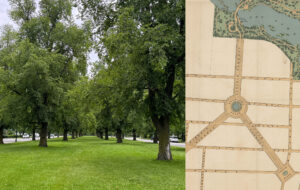
When I eventually did find the marker, the stone was near the entrance (I’ve indicating it on their map), but facing away from it. As glad as I was to have found Vaux’s final resting place, it was disheartening to see no indication of his magnificent accomplishments. The epitaph didn’t even mention that he was an architect, much less the many important projects he worked on: such as Central Park, Prospect Park, the Chicago park system, the Buffalo park system, saving Niagara Falls, designing New York City’s Metropolitan Museum of Art and the city’s Natural History Museum.

For a man who had worked in ornate, carved stonework for his entire adult life, his headstone was as simple as can be, with nothing but a couple flower shapes added for adornment. No one had left any flowers, and only a couple stones were resting on the top. I found an oak twig with a few leaves and acorns on it and placed it among the rocks.

And then I sat quietly for a half hour, alone and completely undisturbed.

Calvert Vaux was a month shy of his 71 birthday when he died in 1895. His body was found in New York City’s East River. He was living with his family in Brooklyn and was known to go for very long walks. Sometimes, he went as far as Prospect Park, where a bridge he had designed had only recently been completed. It’s believed that on one of these walks, he fell from a pier and drowned.

With no one to interrupt my thoughts or question my relationship to the gravesite, I came to think that perhaps this was exactly what Vaux was after for a final resting place. After a career living in the shadow of this friend and partner, I imagine the idea of an anonymous plot shared by his wife in a shady nook of a distinguished cemetery would be exactly what he was hoping for.

Glad I now knew where to find him, I paid my respects and drove home.

Related