Photographing Walnut Hill Park’s Luxurious Lawns

For three Thursdays in June 2025, I visited New Britain, Connecticut to photograph a panoramic tour of Walnut Hill Park in full bloom.
July 28, 2025

Designed in 1870 by Frederick Law Olmsted and Calvert Vaux, Walnut Hill was their second park commission in the state (after Seaside Park in Bridgeport). New Britain was a leader in tool production at the time, sporting a beehive for an icon, and they had a hilltop near downtown where a reservoir was to be built. City planners thought a park on the hill’s slope would be a good addition. Olmsted & Vaux agreed, but suggested the city expand the limits of the park considerably to include more level ground to the west.

The reservoir is now an elaborate Art Deco-influenced memorial to area residents lost in the First World War, but the rest of the park closely adheres to the Olmsted & Vaux plan. Many of the original trees appear to be flourishing. The following is a report of those visits and my general findings. (I’ll discuss the park’s origins in more detail when I post the full park tour in September.)

Each day was fortunately sunny with clouds, my favorite combination for photographing panoramas. Each day that I went was increasingly hot, too. I try to shoot most of my tours around midday. As such, it was always well in the 90s when I got to work. The many spots in the shade were oh-so-welcome.

I’d visited the park once, long ago, during the winter and left unimpressed. As far as Olmsted and Vaux’s original design goes, Walnut Hill Park’s defining feature is the wide open central lawn, and the trees that shade the paths. As such, in the winter, it can be a stark scene. Warm the place up, though, and you’re in business. I had picked the wrong season for a first visit.

On a summer’s day, Walnut Hill Park buzzes.

The top of the war monument can be seen for miles in every direction, and the sweeping lawns are only a couple blocks from downtown. The park is surrounded by a mix of neighborhoods, a hospital, and the New Britain Museum of American Art. The neighborhoods include historic homes, bungalows, and multi-family houses. During my lunchtime visits, the park was always well-used with sunbathers, walkers, joggers, and children running around. The staff from the hospital swarmed the hill in their scrubs and carrying packed lunches. Some took a seat in the expansive rose garden at the foot of the monument and others found shady spots on the grassy slope of the hill. As I circumnavigated the park taking pictures, I regularly encountered the same people doing multiple laps, often in pairs.

Thursdays also appeared to be mowing day. The crews in their huge mowers keep a very tidy park. They glided over the green lawns with precision and courtesy, getting the job done without disturbing people looking for peace and quiet. 

Despite being in the middle of a Connecticut city and only a couple blocks from a highway, the park is remarkably tranquil with wonderful views to distant, rolling hills. As I was leaving after my first day in the park, I saw that a masseuse had brought her table out on to the lawn and was working with a client in the shade. On my final day, I watched the parents of a couple teens drop their kids off near a huge oak tree, so the young couple could picnic together with a view (and the general public as their chaperone).

To be honest, despite being well-loved and maintained, the charms of Walnut Hill Park’s design took a while to reveal themselves to me. I’m glad for the multiple visits so I had time to discover them. 
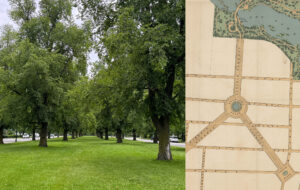
Looking at the original plans, viewing current-day aerial photographs in Google Earth, and just driving through the park, the vast, central lawn dominates. In many of Olmsted’s parks, the key ingredients he worked with were lawn, woods, and at least one water feature all mixed together with interesting topography (valleys, cliffs, boulders) to bring cohesion to the design. Throughout these parks, there are areas to discover that feel isolated from everything else—their own little worlds. At first (and second) glance, Walnut Hill Park seems like it’s all lawn. This isn’t the case, though.

The park has a permeable border—you can cross the sidewalk onto the lawn from almost any direction—but it has at least five distinct entrances. Thinking of the park as roughly the shape of a triangle, the most prominent entrances are at the three corners. Each introduces the park in a different way.

The west gate, furthest from the hill, is a stone and wood lattice with vines growing over it, very reminiscent of Prospect Park’s southeast corner. Here, the homes are distinguished mansions, and the road into the park leads into a shady grove. It’s not quite a forest, but there are enough trees to hide the sunny expanse that awaits. Sloping hills on either side keep the heart of the grove shielded from traffic and quiet.

Stone steps greet visitors at the northern gate, leading up the steep hill to the war memorial. On the way up, the stairs pause at a small patio that includes a smaller monument to the park itself. In the wall around the patio are the busts of the men involved in creating the park with brief biographies. At the center of the patio on a round pedestal is a metal sculpture showing the original Olmsted & Vaux plan in topographical 3D relief. It’s pretty nifty, and an excellent reminder of how faithful the park still is to that plan. From the patio, the stairs climb directly up the hill, lined by trees on either side. It’s a beautiful space. Though the stairs and monument were added decades after the park was initially built, they add a sense of honor and dignity to the park and monument.

The last entrance I found was a small, brick pavilion on the southeast corner of the park, nearest to the hospital. It had benches and plaques commemorating hospital staff, and through an arch there was a walking path that wove its way up the hill to the monument, passing ancient, shady trees on the way. It seemed an ideal way to transition from the demands of the healthcare institution into an outdoor space also designed to offer comfort and healing.

In their original plans, on a large sloping patch of grass on the southern side of the park, Olmsted and Vaux had designed a spot where a water feature might have gone. They pictured a more formal garden with winding paths and a pond in the center. At the time, Olmsted said it was optional, and the city eventually opted against it.

In some ways, though, the war monument that tops the park’s hill assumes the role of the missing water feature. Here, there’s a formal rose garden, a fountain, and symmetrical paths. On the south end is a giant American flag that faces the tall, stone monument (capped by stone eagles) on the northern end. Surrounding the monument’s base is another round patio, this one lined by plaques with names of those from New Britain who died in that first World War.

All through the park, there is excellent signage telling the history of the park and the city. Near the baseball fields, there’s a sign that discusses the city’s sports heroes. Near the bandshell, there’s something on the different concerts and theater performed there. On the hillside is one sign that tells about the early experiments in flight that took off from those slopes. Of course, there’s several signs about Olmsted and his role in the park’s construction. Sadly, Vaux was not represented as thoroughly.

As with all Olmsted and Vaux collaborations, it’s almost impossible to discern who did what when it came to laying out the landscape. Like Lennon and McCartney, they always claimed an equal hand in this matter. But only Vaux designed the structures in their parks. Though I’m not certain, there is a small lunch kiosk in Walnut Hill that very much reminds me of a Vaux design. On my second visit, I visited for lunch. I had a much needed water along with their “Cheese Chop” sandwich and watched a kid hunt for four-leaf clovers nearby. The sandwich and the moment were splendid.

The full panoramic tour of Walnut Hill Park will be posted in September 2025.