
Welcome to my new website!
Here, you will find:
The site’s redesign coincides with a new purpose and direction for me and Panorambles. It’s my goal to photograph panoramic tours of all of Frederick Law Olmsted’s parks, providing free, interactive online versions, and as a series of affordable full-color print books.
For nearly thirty years, I’ve been pecking away at taking panoramic photographs of Olmsted parks, attempting to capture what excites me so much about them. Loosely, in the back of my head, I’ve had a goal of visiting and documenting them all, but given that there are dozens and they’re flung out across the eastern United States, it’s always felt like something that could wait until later.
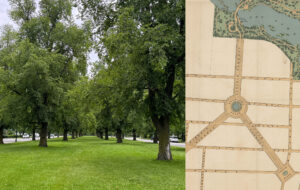
In the last decade, though, the urgency behind this goal has intensified. Recently it’s dawned on me that NOW is the best time to capture these parks in their prime. “Later” feels precarious.
Though I enjoy the process immensely, building a panoramic tour is not quick work. It takes several day-long visits with a camera and tripod to thoroughly cover a moderate-sized park. Much longer for the big ones. Then, there’s processing the images and turning them into tours. That can take months.
In the last five years, I’ve developed a systematic approach. So far, I’ve photographed complete tours of Downing Park in Newburgh, NY, Fort Greene Park in Brooklyn, NY, and World’s End in Hingham, MA. (The last was designed as a housing community, but is currently kept as undeveloped walking trails.) I’ve also done substantial work towards documenting Prospect Park in Brooklyn and the Emerald Necklace around Boston. I plan to spend the summer in Connecticut, capturing their three Olmsted Sr. parks. Last week, I started with Walnut Hill Park in New Britain.
And this fall, my new book will be published: Fairsted. The book includes a panoramic tour of Olmsted’s home office, plus two essays: “How Olmsted Parks Work” and “Olmsted’s Lost Years.” The tour offers a glimpse inside the place where the Olmsted firm created their landscapes. The first essay explains how the parks were meant to elevate the American democracy after the Civil War; the second offers an alternate origin story for how Olmsted came to devote himself to park-building.
There’s much more to come on all these subjects—oodles of pictures, video, and ideas on how we might build on Olmsted’s legacy. I hope you’ll join me.
Related