New Britain is a small Connecticut city nine miles south-west of Hartford.
During the 1800s, New Britain was a center of industry, and their factories were leaders in tool manufacturing. The city became known as “the hardware capital of the world,” and they adopted the beehive as their emblem.
Frederick Stanley’s tool-making business, Stanley Works, was incorporated in New Britain in 1853, and he was also a leader in civic affairs. Along with being the city’s first mayor, Stanley championed a new city waterworks to help in fire protection for the city. To get a reservoir built at the top of the hill near town, he established the Walnut Hill Park Company in 1857. In addition to the reservoir, the company’s shareholders vowed to turn the barren, rocky hillside into a public park.
The waterworks were built in two years, but progress lagged on the park.
In 1866, Stanley had grown impatient. In an editorial to the local paper, he blamed apathy, not the Civil War, for why the park project had stalled. He took it upon himself to contact Frederick Law Olmsted to see whether he and his partner, Calvert Vaux might design the proposed park. The landscape architects were newly reunited after the war and were working on a series of parks in New York City and Brooklyn. Olmsted had grown up in Hartford, though, and his father still lived there.
In 1867, Olmsted stopped by New Britain and surveyed the barren hillside where the proposed park was meant to be situated around the reservoir at the hill’s summit. The walled-off body of water and the rugged ground did not phase Olmsted, but he felt the hilltop too small all by itself to sustain a public park; he recommended its size be more than doubled and land to the west be purchased.
By 1869 the property was acquired, and Olmsted and Vaux presented a plan to the city in 1870. It would be their second park in the state (after Bridgeport’s Seaside Park). In Olmsted and Vaux’s other parks, the main lawns are often tucked away, framed by forest or a body of water. In Walnut Hill Park, though, the vast, luxurious lawn is the central feature. Everything else is dwarfed and pushed to the edges by the green expanse that stretches from the hilltop to the lightly wooded western tip.
In the original plans, Olmsted and Vaux recommended an ornamental garden and fountain could be installed on a southern patch of lawn. The feature was said to be optional, and it was never constructed. Often in other parks, unbuilt features are usually quickly replaced by something else, but in Walnut Hill’s case the patch of land near Hart Street where the fountain was to go is an empty and sunken area that appears more often mowed than enjoyed.
The biggest difference between today and the original 1870 design is that the reservoir at the top of Walnut Hill has been replaced by a large rose garden and a WWI monument now towers over the park. The single limestone column topped by a pair of eagles can be seen from miles around New Britain. Done in an Art Deco style, to my eye, the raised wings look like human hands in prayer. At the base are the names of 123 area men who lost their lives overseas in that conflict.
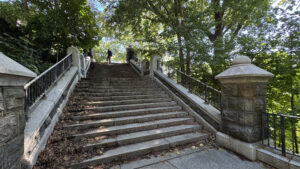
North of this monument is a grand set of stairs descending to a park entrance on West Main Street at the base of the hill. Toward the bottom, the stairs pause in a small, bricked enclosure that mostly commemorates the founders of the park. (The brief biographies of a few other New Britain notables are also included.) In the center of the circular patio, in an elegant touch, is a rendering of the original 1870 plan as a 3D topographical map in miniature, cast in bronze.
Of all the Olmsted parks I’ve visited thus far, Walnut Hill Park has the best and most comprehensive historic signage. They are proud of their Olmsted heritage and celebrate him in multiple places around the park. My one quibble is that it’s only on this rendering of the original plan does Olmsted’s partner, Calvert Vaux, get any credit. When this park was designed, they had just initiated work on the park system in Buffalo, and they were about to design parks in Chicago. To my mind, this elevates the importance of the park significantly and Vaux should be given the equal billing he deserves.
An amphitheater has also been built near the base of the hill, and the lawn has a baseball diamond and tennis courts claiming space. These incursions are minimal, though, and discretely tucked in. Private homes mostly surround the park, but a large hospital occupies the the south east corner. On the north side, the New Britain Museum of American Art looks out over the stretch of lawn Olmsted and Vaux dubbed “The Common.” Not far away is a small lunch kiosk, also with an Art Deco design.
Despite these alterations to the original plans, Walnut Hill Park may be the best preserved and maintained Olmsted (and Vaux) park in New England. Boston’s Emerald Necklace has links in its chain that certainly compare, but the other two Olmsted parks in Connecticut (both in Bridgeport) could learn a lot from New Britain’s example. I will discuss those parks when I post their tours early in 2026.
To photograph my tour of Walnut Hill Park, I visited it on three different Thursdays in June, 2025. To get the best light, I arrived shortly before noon and stayed until around three. Each day was bright and hot. Photographing in the direct sunlight was brutal, and I tried to stick to the shade. Everywhere I went, people were enjoying the park. Many, like me, chose the shade, but there were walkers everywhere doing multiple loops. Some had dogs with them, but often, it seemed they were staff from the hospital, getting their steps in, or finding refuge from what they faced at work.
While everyone I met was courteous, it was an uncommonly quiet park. Few people ever exchanged greetings. Though well-used, it’s such a large, open park, it’s hard to bump into anyone else unexpectedly. With so much room, it’s easy to find a vast stretch of lawn and call it your own for a while.
Related