Fall River is a city overlooking where the Taunton River flows into Mt. Hope Bay in south Massachusetts. It has a deep water harbor that once imported cotton and exported textiles. Now, it hosts a museum of WWII war ships. The city limits border with Rhode Island.
During the Industrial Revolution of the mid-1800s, the city’s population grew quickly to support the business booming in the mill buildings. Many of the workers were Irish and French Canadian immigrants. The influx of new families outpaced city planners and overcrowding became the norm. City leaders and area industrialists began acquiring land for a park in 1868, and in 1870 they asked Frederick Law Olmsted and Calvert Vaux to visit the city and make recommendations.

Along with delivering a plan in May 1871, Olmsted wrote, “Although the natural advantages of your city for refined and healthful out of door recreation are very great, they seem thus far to have been singularly disregarded and the wealth which exists in them wasted. Your narrow streets and the habitual confinement of a large part of your population within walls during the greater part of the day makes it particularly desirable that some such comprehensive scheme as we have suggested should be adapted.”
The park he and Vaux proposed was a 54-acre rectangle of pasture land. To the east was a broad plain, but heading west, the flat land gave way to a rocky hill slope that lead down to woods along the water. The crest of the hill offered sweeping views of Mount Hope Bay.
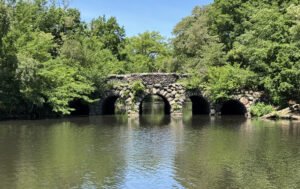
The landscape architects recommended keeping the flat land to the east for sports and athletics, but to the west of Broadway (which cuts through the park), they proposed tree-lined carriage roads, a pavilion near a garden, playgrounds, and a shelter looking across a deer park to the bay. The carriage road descended the hill, through the deer park, and crossing a train bridge, they proposed it lead to an overlook with a balcony that be built directly on the water.
Elements of the plan were in place when the financial downturn of 1877 struck, but then development stalled. For decades, the incomplete park languished, until the Olmsted firm was called upon again. John Charles Olmsted visited the city in 1904. Along with providing plans for other parks in the city (building off the recommendations of Vaux and his father), he also offered a revised plan for South Park to update that work.

Details from this revised plan are what’s most evident today. John Charles added paths to the playground east of broadway and designated places for ball fields. In the center of the park, he provided greater definition and added the current shelter. His plan included the concert grove in front of the shelter and a wading pool just outside a “children’s building.” The area closest to the bay included a more developed balcony, stairs leading down to the water, a boardwalk, another wading pool, and another shelter.
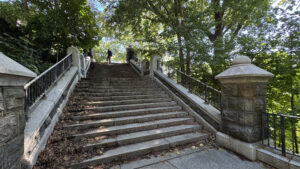
Early picture postcards of the park show a vibrant park being used as the designers intended. The fountain and wading pool outside the children’s building glimmered in the sunlight and was mobbed by children looking to cool off. Flowers and bushes were in bloom around the base of the shelter, and a majestic set of well-lit stairs led down to the carriage road.
An article from The Herald News on be 200th anniversary of Olmsted’s birth describes the park’s importance to the city:
“As the jewel in Fall River’s parks, South Park is the starting point of parades and the site of major events like the Great Feast of the Holy Ghost. President William Howard Taft entertained tens of thousands of people in 1911 during a days-long festival to mark the 100th year of cotton production in Fall River. Thousands saw President Bill Clinton in 1996 stumping for Democratic candidates John Kerry and James McGovern. In 1963, the city renamed South Park for a president: John F. Kennedy, to honor the mark his assassination left on the public.”
The park’s name change appears to coincide with an overall shift in the landscape’s objectives. In the years since the colorful post cards, the lawns are still well mowed, but war memorials and athletic courts have prospered across the park while the paths and plantings have been allowed to fade and get overgrown. A skating rink or wading pool without any water looks a lot like an empty parking lot, which is what I thought it was before seeing the historic photos.
In the space John Charles Olmsted designated as “The Meadow,” today there’s a large patch of empty, mowed grass surrounded by a barbed wire fence. A public swimming pool had spent decades in that spot before being filled in; the barbed wire fence and shuttered changing rooms still stand. Anywhere, it would be an eyesore. Surrounded by homes in a quiet, bayside neighborhood, the well-protected empty patch defies reason.
While decay and neglect have been allowed elsewhere, a brand new pickleball court has been installed where once there were woods. The fenced-off court, with its porta-potty and stadium-style night lights, is very far removed from the area originally designated for such sports. Its also directly between the shelter and its view of the bay.
Across the bridge, down by the bay, there’s a dusty field where it doesn’t appear any balcony, concourse, or boardwalk was ever installed. What you might expect to be the richest part of the park, feasting on the open water views, instead looks ideal for dirt bike racing. The narrow path down to the water is cluttered with trash and tangled fishing line. When I photographed the spot, I shared it with a guy eating his lunch from the cab of his telephone utility truck. My guess is he was utterly perplexed as to what I thought was so interesting about the vacant lot.
I visited Kennedy Park on September 11, 2025 on a sunny weekday. Because it was around noon, the people in the park were mostly older people walking their dogs, working people eating their lunch, or parents with toddlers. Still, except down by the bay, I never felt alone, and everyone’s mood was relaxed and friendly. I often get glances taking my panoramas, but in Kennedy Park, I also got a lot of polite, curious questions. Most people seemed to know who Olmsted was and were proud that their city had a park by the distinguished designer.
Indeed, there’s a fine mural on the side of the utility garage showing a portion of John Charles Olmsted’s plan and a photo of his father. Elsewhere, the welcome sign specifies that the park was originally designed by “Olmsted and Vauy [sic].” Many whom I spoke to suggested the place had seen better days, and one older guy was even angry about the park’s condition.
“I used to work for the city,” he told me, “and everyone knows the park needs work. But it doesn’t matter that it’s an Olmsted. The state doesn’t care. They’ve got their Boston Olmsted parks. What do the Feds care about this place? I told the city the concrete they were laying down for footpaths was going to crumble, and look at it now! You can hardly see them. Don’t get me going about that damn swimming pool.”
I was glad I did ask about the pool, though. If he hadn’t explained, I wouldn’t have understood what I was looking at when I stood in front of the the barbed wire fence later. He said the pool had been closed up for as long as he could remember.
“Fall River deserves better,” he said, and I agreed.
Related