Their proposal went like this: If the city of Newburgh, NY provided the land to build a new park, Frederick Law Olmsted and Calvert Vaux were willing to design it for free—provided the park was named after their hero and mentor, Andrew Jackson Downing, who once lived in the city.
They made their proposal in 1887, encouraged the city to expand the future park’s dimensions in 1889, and the final design was prepared in 1894 (with considerable help from their sons, John Charles Olmsted and Downing Vaux). The following year, Vaux drowned in Brooklyn, and Olmsted was forced to retire for health reasons.
Though some refer to Olmsted as “the father of landscape architecture,” he was following Downing’s teachings and example. Until his untimely death in a steamboat accident, Downing was the nation’s foremost proponent of building a magnificent public park in the center of New York City. Indeed, he thought public parks should be designed everywhere to improve the health and character of the city dwellers who visited them.
Downing owned a plant nursery with his brother in Newburgh, and he also published a popular journal, The Horticulturalist, which included essays on home and landscape design. The success of the nursery and publication led to his third business: he was a landscape designer for people’s estates up and down the Hudson River. Downing hired the young architect Calvert Vaux in London and brought him back to Newburgh to work in his design office with him. Later, Downing published Olmsted’s first article in his journal.
Without Andrew J Downing, there likely wouldn’t have been a giant park to build in Manhattan, and the two men would have never met. Wanting to acknowledge his importance to the American public park movement, Olmsted and Vaux first proposed a statue be erected in Central Park’s Ramble to salute him. They tried to raise funds before the Civil War, but the project was never completed.
Though their formal business partnership only lasted roughly fifteen years (with a four-year gap in the middle), Frederick Law Olmsted and Calvert Vaux remained friends and colleagues for the rest of their lives and careers. On a number of occasions, the two later reunited and worked together on select projects—most notably, turning Niagara into a national park and completing Morningside Park in Harlem. The ideals Downing championed were fundamental to all their collaborations.
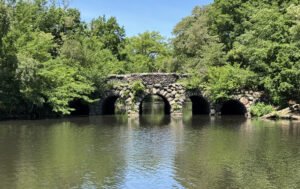
As their final project together, Downing Park includes the three key ingredients for Olmsted and Vaux’s urban parks: a forested hill, rolling meadows, and a large pond. Perched on the southern slopes near the summit of a hill in the center of town, the park gets great sun all day long. There’s also an astonishing view of the Hudson River from the highest point in the park.
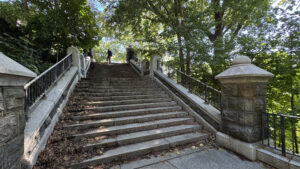
Once, this viewpoint at the top of the hill had a large, wooden lodge that Vaux had designed with a broad second-story veranda. It was called the Observatory. Now, there’s just a dusty cul-de-sac where I usually have found a couple cars idling and playing loud music behind tinted windows. On one occasion, I watched turkey vultures circle overhead. Lower down on this same hill where the groundhogs live, there’s a white Pergola that might be perfect for parties (if the graffiti were cleaned off every visible surface), but there are signs all around it reading, “Keep Off Pergola.”
The eastern side of the park, a hillside sloping up to the Pergola, is covered in forest with a fringe of lawn and sidewalk along Dubois Street. It’s my favorite part of the park. I like how the paths disappear quickly into the canopy, and walking along them, suddenly the city is far, far away. In a couple encounters I’ve had while photographing there, I learned that others living in the neighborhood also enjoyed this sense of seclusion for activities best done where the shade is deepest.
Carpenter Avenue runs down the center of the park, north to south, and it bisects it in equal portions: to the west, a place where you might take your kids for a picnic, and to the east, not so much. Joan Shapiro Drive politely snakes through the north western part of the park, leaving alone the very walkable paths around the lawns and a pond. The eastern hillsides, though, are largely crisscrossed by roads. The paths are less clear, and as I suggested, quite shady.
Over the last year, I’ve visited Downing Park three times, and every time, the western part of the park with the lawn and pond are being well used by families and groups of kids. Along with the shelter house by the Polly Pond there are other features to explore. There’s a discrete rock amphitheater for plays and concerts, and a large boulder across the lawn that quietly urges everyone to climb on it.
Much to the city’s credit, unlike most other Olmsted parks I’ve visited, Downing Park is free of baseball diamonds, or any basketball or pickleball courts. No playgrounds, either. As a fitting tribute to Downing, the park invites passive recreation in a natural setting and provides a common ground for everyone in the city to enjoy.
Less to the designers’ wishes, perhaps, many memorials have been added throughout the park. Along Dubois Avenue to the east, there’s a monument for local firefighters. Near the place with the best view is a memorial garden and plaque of a local who enjoyed that spot. The western part of the park has monuments to veterans of two wars, and a plaque to a local Downing scholar, David Schuyler. All are well-designed and respectfully done, but each also chips away at the park’s purpose—an escape from the built world.
In 2024, when I first visited Downing Park, there was talk about adding an even larger memorial than the others already around the park. A new tomb would include a sizable monument, gardens, parking, and educational displays about those buried there. Thankfully, there seems to have been little progress on this dubious goal.
Downing Park is already a memorial to someone who lived in the city. To honor his memory and improve the lives of the park’s neighbors, give the eastern half of Downing Park the funding and attention it needs to match its western half. Build a new Observatory to improve the view for everyone. Limit cars, improve the foot paths, and fix the damn Pergola.
Related