The network of connected parks that wrap around Boston is known as the Emerald Necklace.
The elaborate greenway includes the historic Boston Common, Public Garden, and Commonwealth Avenue Mall, but the other six links (most of them parks) were designed and built by Frederick Law Olmsted and his firm during the 1880s and early 1890s. Olmsted lived and worked in Brookline, an adjacent town. His home and office, Fairsted, was only a short walk from several of the parks. The Emerald Necklace was his last, finest, and possibly most personally significant park system.
In 1893, he wrote to the other members of his firm, “Nothing compares in importance to us with the Boston work… I would have you decline any business that would stand in the way of doing the best for Boston all the time.”
Most of the links in Olmsted’s Emerald Necklace celebrate the landscapes and geological features of the environments they inhabit. Jamaica Pond has been there since the last Ice Age; Olmsted’s work frames it. Puddingstone, the predominant kind of rock found in Franklin Park, is made a chief design motif throughout. The Back Bay Fens is a park that tames what was once a swampy, polluted estuary off of the Charles River, turning it into an idyllic walk.
Riverway Park, though, is the one link in the chain that was entirely fabricated.
Originally, the stretch was known as “the Muddy River Improvement.” As Olmsted described the purpose of the park himself, “like the Back Bay Fens, the goals for the Riverway were two-fold; to transform the river, which was an open sewer, from a public nuisance into a community asset, improve flow and water holding capacity, and to create a linear park.”
“Linear” describes the park well. Other segments of the Emerald Necklace have natural features that add complexity to the path layout. Winding rivers, ponds, meadows, and forests all offer varied terrain to craft a park from. In the Muddy River Improvement, though, Olmsted turns a narrow stream bed wedged between two thriving neighborhoods (these days, it’s the kind of ravine you might find a shopping cart graveyard) into a sylvan glen that seems to run forever.
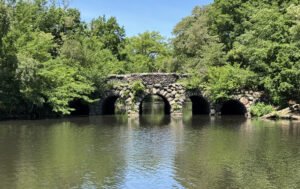
Even though the park snakes between a heavily travelled roadway to the east and a busy trolley line to the west, the cars running on either side are almost invisible during most seasons. Steep embankments keep the sound distant. Instead, your focus is on the river, the river banks, and the bridges that majestically pass through. For long stretches walking along the river, there are no branching paths, but the bridges keep you from feeling constricted or trapped. By offering path options to switch banks easily, it’s possible to choose an alternate path to walk each visit.
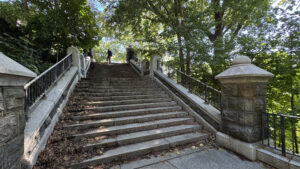
Unlike some other Olmsted parks, there is a uniformity of design throughout the bridges in Riverway Park. Many of them are a smooth-faced, light granite, tightly constructed, with sweeping lines. They are unobtrusive, blending in as the designers intended, but they also include surprises: a winding set of stairs, a balcony, or a bench built into the granite.
Credit for the architectural design of the bridges is given to the firm of Shepley, Rutan and Coolidge, but as historian Cynthia Zaitzevsky points out in her detailed study, Frederick Law Olmsted and the Boston Park System, the firm’s work was mostly to create architectural drawings based on sketches made by John Charles Olmsted (and approved by his father and business partner). Her book also reveals that the Olmsted firm originally wanted the bridges to be made of different materials and have a variety of designs. The architects and Brookline officials urged for the uniformity, no doubt to cut expenses. Still, the bridges were among the most expensive features in the park, and some were not completed until after the senior Olmsted retired in 1895.
Shepley, Rutan and Coolidge was the architectural firm formed by the colleagues of H. H. Richardson, the world-renowned architect who designed, among many other astonishing buildings, Trinity Church in Boston. Richardson and Olmsted were good friends. The famous architect was an important motivation for Olmsted to move from New York City to Brookline. He wanted his friend to be within walking distance; they both wanted to become neighbors. They had collaborated on a number of major projects before the Boston park work began, and Richardson had started to contribute designs for bridges, utility buildings, and shelters throughout the Emerald Necklace before his untimely death in 1886.
After Olmsted had been introduced to landscape design by his mentor and first partner, Calvert Vaux, Richardson was the second major partnership of Olmsted’s career. With the Emerald Necklace, and particularly Riverway Park, we see Olmsted’s stepson emerge as the third and final partnership. John Charles had been working with his father for years, and his much younger brother, Fred Jr., had also started apprenticing with the firm during this time. After Richardson’s passing, though, John Charles assumed the role of architectural counter-point to his father’s landscape designs.
Today, the Riverway retains the lushness the Olmsted firm intended and is well-maintained by the Emerald Necklace Conservancy with dredging and new plantings taking place periodically. The original design is mostly still intact. The exception is on the northern tip of the park, where there once was a lagoon and stone bridge meant to act as the elegant linking feature to the Back Bay Fens. In 1959, the city sold this area to the Sears Roebuck company. It was filled in and used for a parking lot. It has since been reclaimed by the city, but the original features have been lost.
Related