The Power of Panoramas

When I read fiction, I like a narrator. Third person, omniscient. It’s the same with my photographs.
June 7, 2025

The panoramic images I take capture everything. In one panorama, I have the entire sphere of wherever I took the image—everything in all directions, excluding me and my camera. When I visit a park (or any historic location), I plant my tripod down and take nearly a hundred shots in every direction and stitch them together later. I do this multiple times. With software, linking these panoramas together, I create interactive tours and picture books that recreate what it’s like to wander these parks at will.

My interest in Olmsted predates panoramic photography, but as both fascinations matured, it was clear they belonged together.

Like an owl able to pirouette its head, Frederick Law Olmsted thought in three hundred and sixty degrees. A filmmaker or a painter might hold up their fingers to frame a shot, but the landscape architects needed to consider how each scene they created looked from every angle, in every light and season. Now and in the future.

To my mind, other than actually visiting a park in person, panoramic photography provides the next best sense of how Olmsted composed his scenes, or what it might be like being in one of his parks. There are millions of excellent traditional photographs of Olmsted parks, but even after having seen my fair share of them, I only have a vague sense of where I’m looking in any particular shot and no overall idea of the parks themselves.
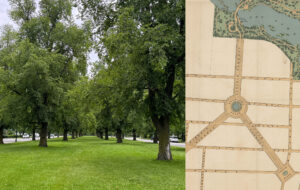
A tour made up of linked panoramic images provides the context and composition missing in any traditional, framed photo—and a panoramic tour that includes photos and videos linked throughout combines the best of all formats into an experience that is almost as immersive as a park.

Along with capturing the scenery, people, and structures in a park, panoramic photography helps me capture the sense of freedom and choice Olmsted’s parks offer. 

I love when an unexpected path appears, or a set of stairs suddenly climbs a steep embankment, leading somewhere into the trees above. Olmsted deliberately did not name his paths and preferred as little pathway signage as possible. Getting a little lost was part of what he hoped his designs would achieve; Olmsted wanted you to explore and find the treasures that lay waiting. A blue heron unfolding in all its origami precision and sailing off across the water. A pile of turtles sunning themselves on a log. A wide open meadow covered in a haphazard quilt of blankets, tarps, and towels. Everywhere, dogs and children are running between these islands of food, drink, and cheer.

It’s not possible, of course, to capture every inch of a space, or even every path. My goal is to give a curated overall sense of the place, not a complete record of every bench and tree. To keep the links between each panorama clear, every time I plant my tripod down, I make certain I can see the previous location where I photographed. I seek out branches in the path and try to photograph where each branch goes. This often can take multiple visits to complete, and connecting paths photographically can bring me real satisfaction.

Last November, for instance, I photographed a connected route through Prospect Park in Brooklyn, NY. I started in Grand Army Plaza to the north, worked my way along the Long Meadow to where the stream leads down the Ravine to the Nethermead. This past Memorial Day weekend, I photographed the southern end of the park, along the lake, up the west side of the park to Lookout Hill. After two days shooting, I was able to connect to the images I photographed over half a year ago in the Nethermead—an open meadow in the center of the park. I still have many areas to fill in, but I’ve now reached three corners of the park.

Related