

Like the wardrobe leading to Narnia, or Dr. Who’s time traveling Police Box, Morningside Park in Harlem is deceptive—almost magically, so. There are worlds within worlds beyond the unassuming, open gates of this tiny park. Of course, no two parks designed by Frederick Law Olmsted and Calvert Vaux were ever the same, but this one is exceptional.
At just 30 acres in size, it’s much smaller than many of their parks. All the same, Morningside packs an incredible amount into the confined space, always giving you the sense the boundaries are much further away than they really are. Often when they built parks in cities, Olmsted and Vaux were given choice properties to work with—lush expanses with rolling hills, forests, and streams. The site in Harlem, though, was a steep, rocky cliffside no one wanted to build on.
The challenge of mastering this vertical space resulted in a park with four, long, narrow tiers. Each has its own, distinct feel. Each separated from its neighbors by a steep, rocky incline.
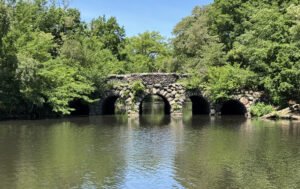
The park’s overall dimensions are one block wide (east to west) by 13 blocks long (north to south). The eastern side of the park is the lowest, and it includes a large lawn to the south, a small pond fed by a waterfall, and then a wooded path that runs through a network of playgrounds and basketball courts in the north. Sets of stairs appear through the woods all along the western side of this strip of land, leading up to the second tier, a wooded walk midway up, along the cliff face. More stairs climb to a third, narrow path that runs along the base of a massive retaining wall that holds up the western side of the park.
Finally, the sidewalk at the top runs along the park’s tree canopy, looking eastward across to the rooftops of Harlem and to the sunrise. All along the wall, there is seating in observation balconies along the wall, and on the grand entrances to the many grand staircases descending into the shady park.
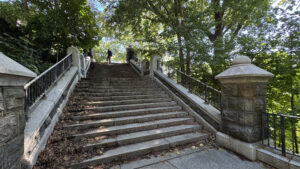
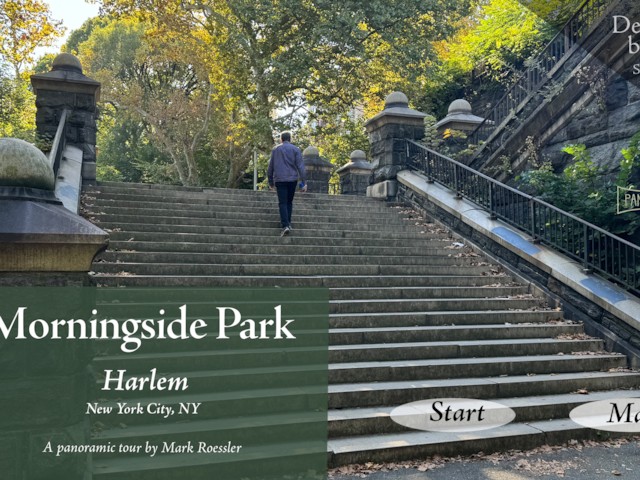
Often bridges act as a key architectural feature in Olmsted’s parks, but in Morningside, it’s an abundance of stairs. Sweeping entrances, gradual climbs, and steep ascents—the stairs come in all varieties. Those along the wall descend in stages, twisting down into the forest. In the southwest corner of the park, a flight has been hewn directly into the rock.
As critical as the staircases are for reaching the different parts of Morningside, they often act as a kind of maze. Some flights cut directly across the park, but many don’t. Get to the bottom of one flight, and you’re in a wooded grove, needing to find another stairway. As is the custom in Olmsted parks, signage is scarce, so either you need to explore, or ask someone. Either outcome would satisfy Olmsted’s goal of making his parks democratic spaces that connect strangers.
Several times while I was photographing the pathways along the cliffside in Morningside Park, I was asked by confused fellow visitors for directions. More than once, they were just a staircase away from where they needed to go, but they’d given up trying to navigate alone. I was glad to be the one who got to help them.
Morningside Park is just a block north of its much larger cousin, Central Park, and along with Olmsted and Calvert Vaux, the smaller park owes its existence to others who worked on America’s first public park.
Andrew Green, during an early stint as the New York City parks commissioner, first suggested the rocky cliffside up in Harlem could be turned into a park. In 1868, the land was acquired for that purpose. Before the Civil War, in the early years of Central Park, Green was the park’s comptroller and one of Olmsted’s bosses. After starting off as friends, Green and Olmsted began feuding over expenses, prompting Olmsted to quit the park. They remained lifelong adversaries, and their paths crossed at several critical junctures later in their lives.
In 1873, Olmsted and Vaux provided plans for Morningside Park. The plans were approved, but work stalled for 14 years during a lengthy recession. In 1880, Jacob Frey Mould was invited to prepare plans and complete the job. Mould had collaborated with Vaux on the design and ornamentation of the buildings and bridges in Central Park, including Bethesda Terrace. For Morningside, Mould introduced the buttressed wall at the top of the Morningside with its promenade with expansive views. When he died in 1886, several other designers were approached to complete the work, but the project ultimately went back to Olmsted and Vaux. Apparently, Andrew Green was back in charge and had wanted only Vaux to work on completing the project. Vaux insisted he would only do the work with his former partner.
Deliberately, the park shares many features with Central Park, making them feel related. The low stone walls surrounding portions of the park, the multiple entrances, winding paths, benches, and stately stairs all lit by glow of the ubiquitous lamps—these details all mirror the bigger park to the south. The cliffs of Manhattan schist are a clear connection, too. But there’s a key, important difference between the two parks.
No roads or carriage paths cut across or weave through Morningside Park. Because of the stairs, bicyclists tend to keep to the lowest level, or avoid the park entirely. At the northern end of the park, there is a wide path that climbs the whole park without stairs, but it’s out of the way and winds so much that it’s not used as a speedway. This lack of traffic brings a between-two-worlds tranquility to parts of Morningside Park all its own. There’s a sneaky kind of joy being able to hear the busy world around you, but knowing you’re in a special, hidden place not far away, where no one but the birds and squirrels can see you.
The park’s intrepid design has also been remarkably resistant to change. Those additions that have been made have largely respected the magic of their environment. Early on after the park was completed, statuary was installed. At the top of the 116th Street stairs, a balcony was transformed into a monument for Senator Carl Schurz, who stands with his back to the park. In the pizza wedge between Manhattan and Morningside Avenues a statue to honor the partnership between Lafayette and Washington was installed just outside the park. (It’s a moving portrait of the two men, but its full-effect is hidden behind the massive branch of a glorious sycamore.) Just north of there, a third statue, the Seligman Fountain by sculpture Edgar Walter, represents of a young faun hiding from a curious bear. Built into the metal work are two water fountains—one for fauns and the other lower down for bears, presumably.
In all the different original designs for the park, the paths extend the full length of Morningside Drive and had half a block of frontage on Amsterdam Avenue. Today, a public school stands at that address on a massive rock outcropping. A path in the northwest corner of the park heads off towards this phantom part of the park, but it ends abruptly, cut off by the school. I’m not certain what happened here.
Baseball diamonds and basketball courts were also added, along with several playgrounds, in the 1930s and ‘50s. Bathroom facilities and a small park office complex also were installed. In the 1960s, though, the biggest change to the park was attempted by Columbia University.
The park stands on the border between Harlem and Morningside Heights, two neighborhoods in northern Manhattan. The rift between them is more than geological. Economic, cultural, and racial differences have dominated the politics and interactions between them even in Olmsted’s time. Amidst expensive apartment houses at the top of the cliff, the cathedral of St. John the Divine has been under construction for decades, overlooking the park. The campus of Columbia University extends throughout Morningside Heights, and students are often on the stairs, descending to the lower regions. At the bottom of the cliff is a neighborhood of black and minority families, schools, and places of worship.
The contrasts may be less distinct these days, but the 1960s were a time of civil unrest and the park bordered two neighborhoods literally and figuratively on different levels. Looking for land to install a new gymnasium for their students, the university decided Morningside Park would make an ideal location. Outrage at the presumptuous notion that public land was available for the school to use as they pleased spawned a movement to resist and stop development. It included park neighbors and Columbia students. Protests were not enough to stop the university from digging a foundation for the building, but that’s where development stopped.
The foundation that was dug by bulldozers became the pond and wildlife sanctuary that’s at the heart of the park now. The university helped add a waterfall to complete the scene, and professors from the biology department recently volunteered to help address the algae.
The success of the movement to protect the park gave birth to the park conservancy. The organization continues to work with the city, university, and all stakeholders to keep the park magnificent and magical. A comprehensive review of the stairs in the parks was recently completed by the city, and with the new mayor’s commitment to the parks, Morningside may soon be given the care it continues to deserve so richly.
Related