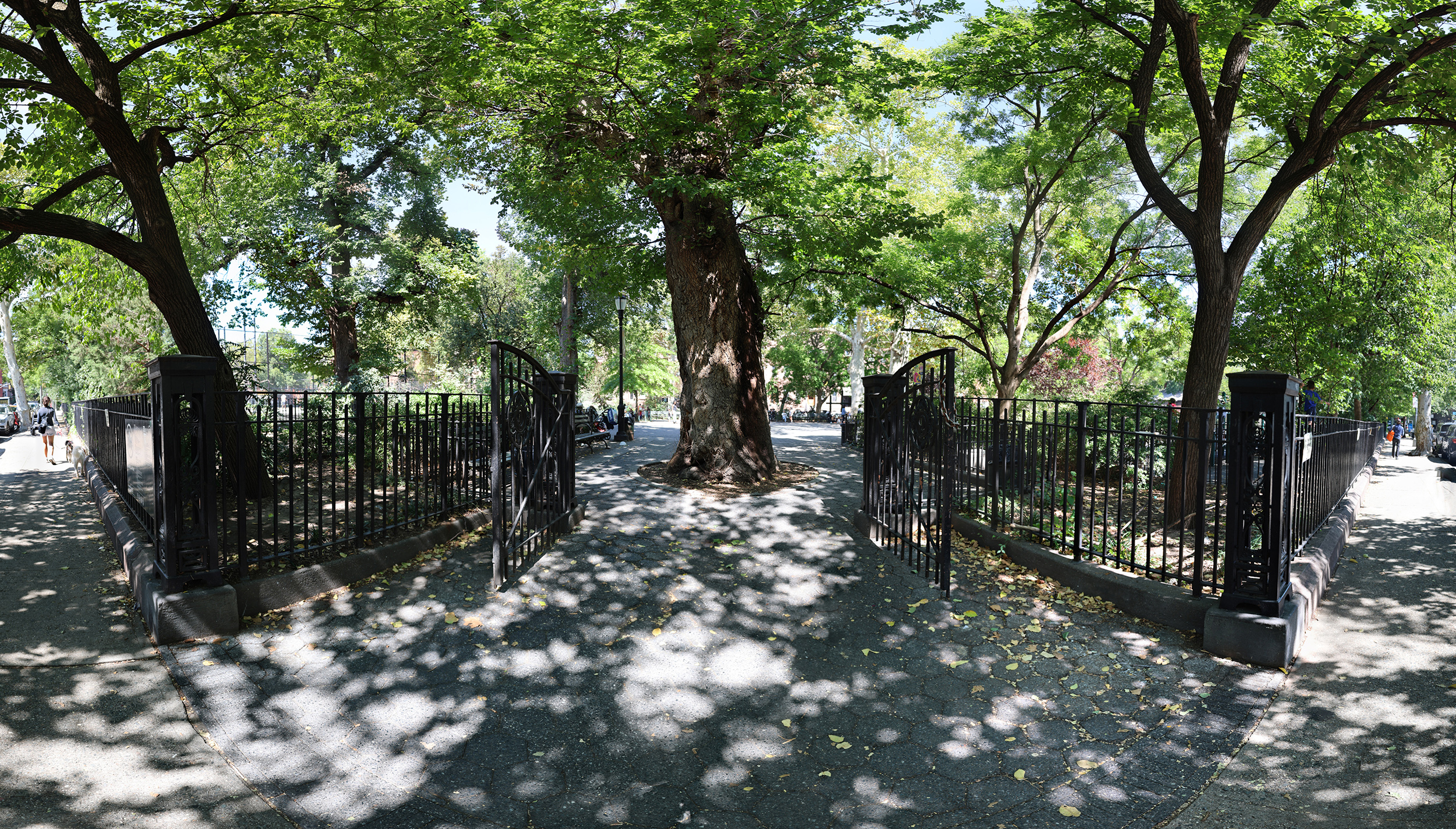


Strictly speaking, Carroll Park is not an Olmsted park.
It’s tiny—only 1.8 acres—and it’s not included on the Master List of the firm’s projects. While the signage in the park notes that revisions and updates were done to Brooklyn’s third park around 1870, it doesn’t identify that Frederick Law Olmsted and Calvert Vaux were responsible. While the two worked on designing and building Prospect Park across town, they received several smaller commissions in the city, including Carroll Park.
Brooklyn’s first park was known as City Park (now Commodore Barry Park). The second was Fort Greene Park, which Olmsted and Vaux redesigned completely in 1867. The third was Carroll Park, named after one of the signers of the Declaration of Independence, and the fourth park was to be Tompkins Park (now Herbert Von King Park), which they would also design and build.
In their report to the Brooklyn Park Commissioners on January 1, 1869, Olmsted and Vaux mostly discussed the ongoing development of Prospect Park, but at the end, they reported on their other projects.
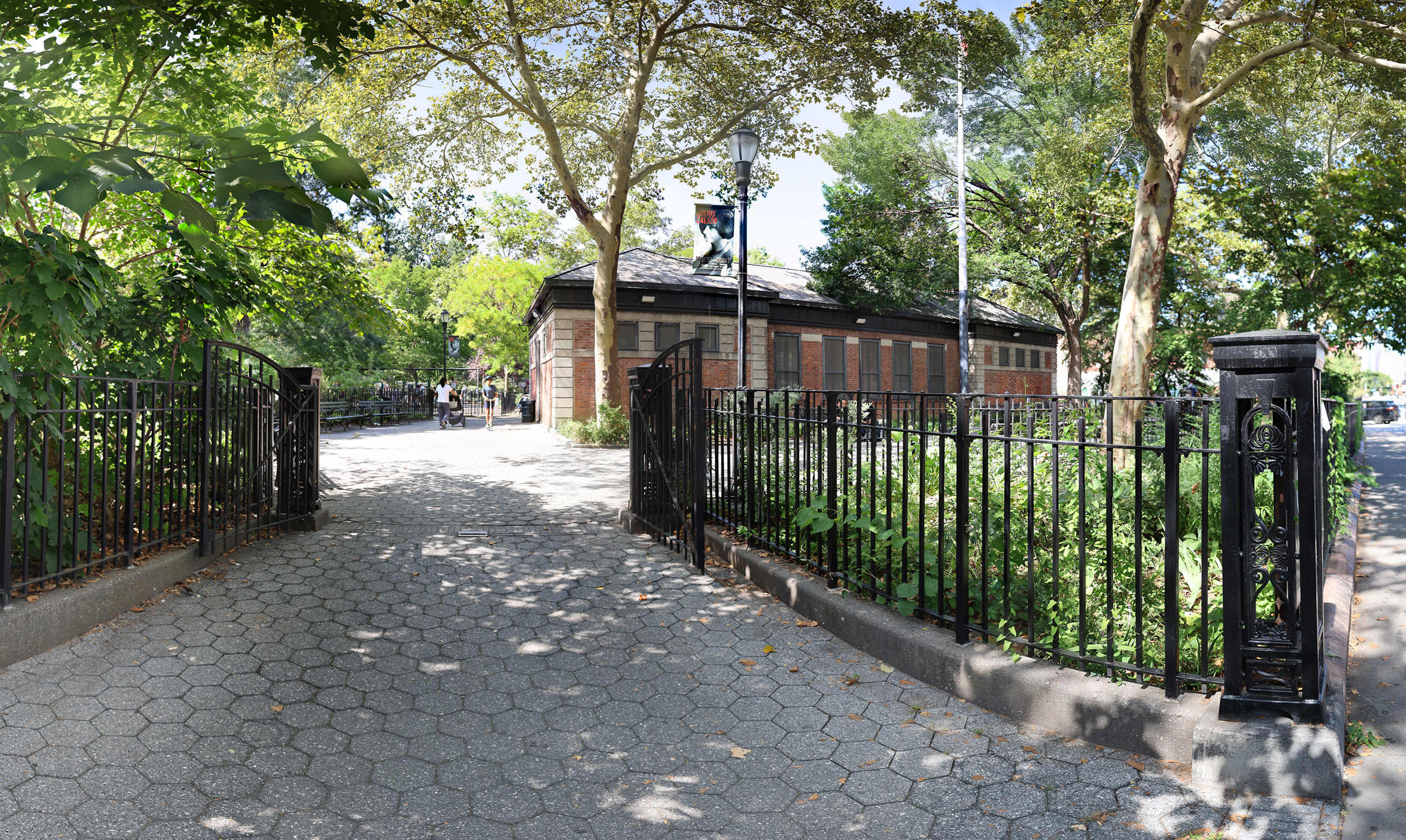
“The plan of Carrol Park [sic], as it originally existed, has been revised, the length of walk being considerably reduced, the width increased, and other changes made. The walks have been laid with the Fiske patent pavement, on a new plan, slightly dishing to the centre, so as to avoid the necessity of side gutters. The plan is found to work well, giving practically an increased accommodation, and causing apparently no perceptible greater inconvenience. An open area in which children can play without interrupting communication on the walks, has been formed at one end, and in this paved space fixed swings and see-saws were set up just before the close of season. Two small houses for the accommodation of visitors, with refreshment stands, tool closets and water closets, have been erected. A decorated flagstaff has also been lately set up.
“None of these improvements were completed until the end of the season, but the effect in increasing the value of the Park to the public was evident during all the latter part of the summer and autumn in an attendance fully twice as large as was observed the previous year.”
A subsequent report from John Bogart, an assistant engineer, indicated that “…fifty-two park seats of iron and wood were placed at convenient points about the park. One hundred and fifty bird-houses for the use of the sparrows were put up in the trees.”
According to the signage in the park, Carroll Park began in the 1840s as a private garden for the residents of a neighborhood laid out by surveyor Richard Butts. (This area now comprises the Carroll Gardens Historic District). Brooklyn acquired the garden in 1853 and turned it into a city park. After Olmsted and Vaux’s updates in 1868, there were renovations in the 1890s, 1930s, 1960s, and in 1994 the park underwent a $1.3 million capital reconstruction and redesign.
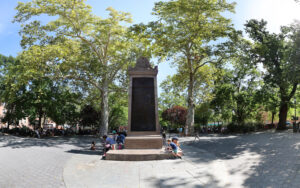
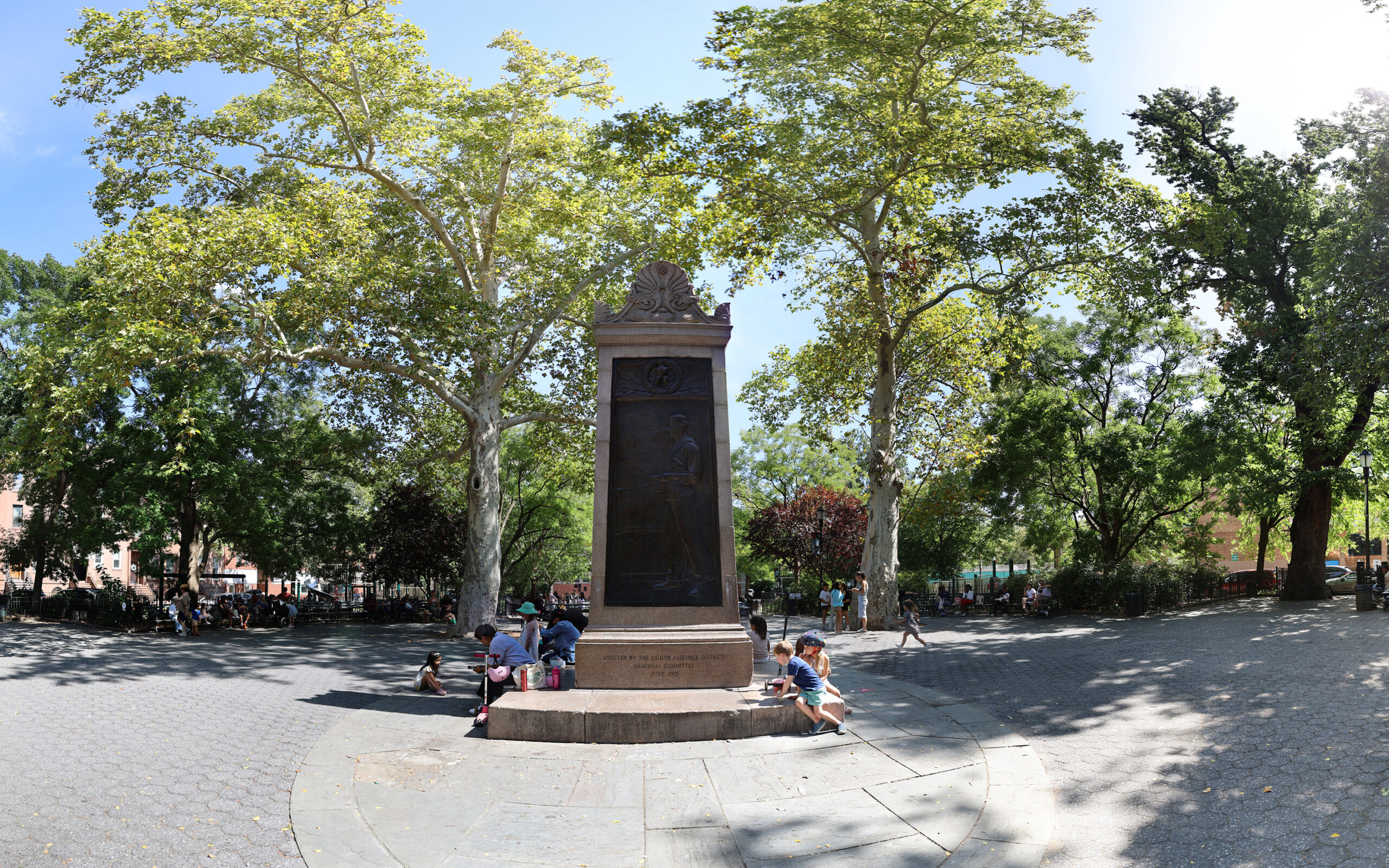
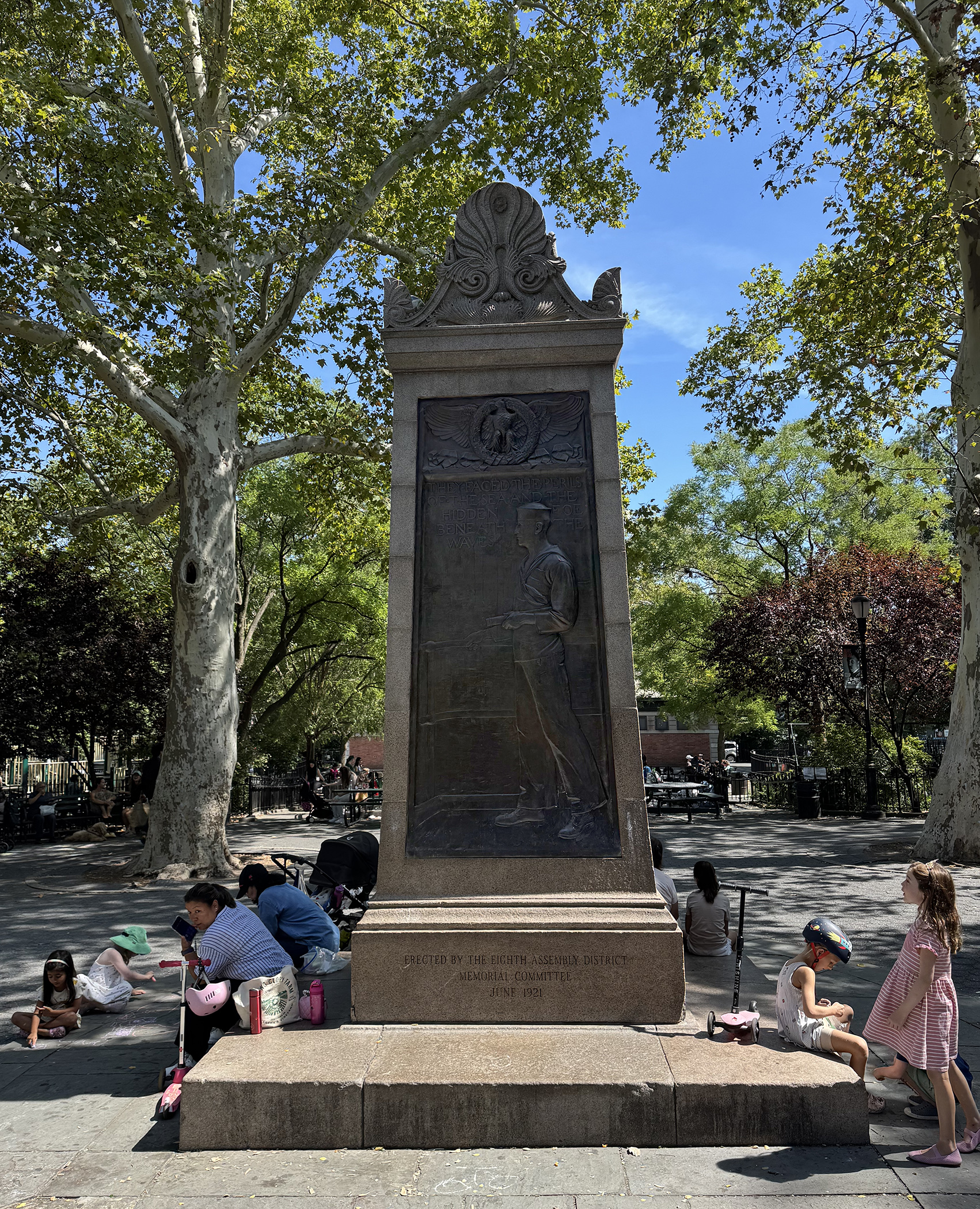
The Soldier and Sailors World War I Monument was made by sculptor Eugene H. Moral and added in 1920.
In 1975, the Committee to Improve Carroll Park was formed, and working in partnership with New York City’s Parks department, they maintain it.
I visited Carroll Park in early September 2026 expressly to document it. I knew it was small enough that it would only take me a few hours, and I had plans later in the afternoon. The day was hot, clear, and perfect. Circling the blocks in the neighborhood, looking for an open space for my car, the glimpses I had of the park were promising. I was looking forward to slipping in, exploring, taking my photos, and then being on my way.
The moment I crossed Court Street and set up my tripod to photograph the first panorama in my tour of the park, my cover was blown. Instead of blending in, I was attracting attention. An older gentleman just up the block made eye contact with me. Only a few photos into my afternoon project, he was curious and he had questions. He asked in Brooklyn-ese—gruff, hard-edged, but utterly polite.
What are you photographing? Where are you from? You know Louis?
The first two questions were easy, and I explained myself. But the third one stumped me. We’d been talking only minutes; it seemed premature for us to have mutual friends. Louis?
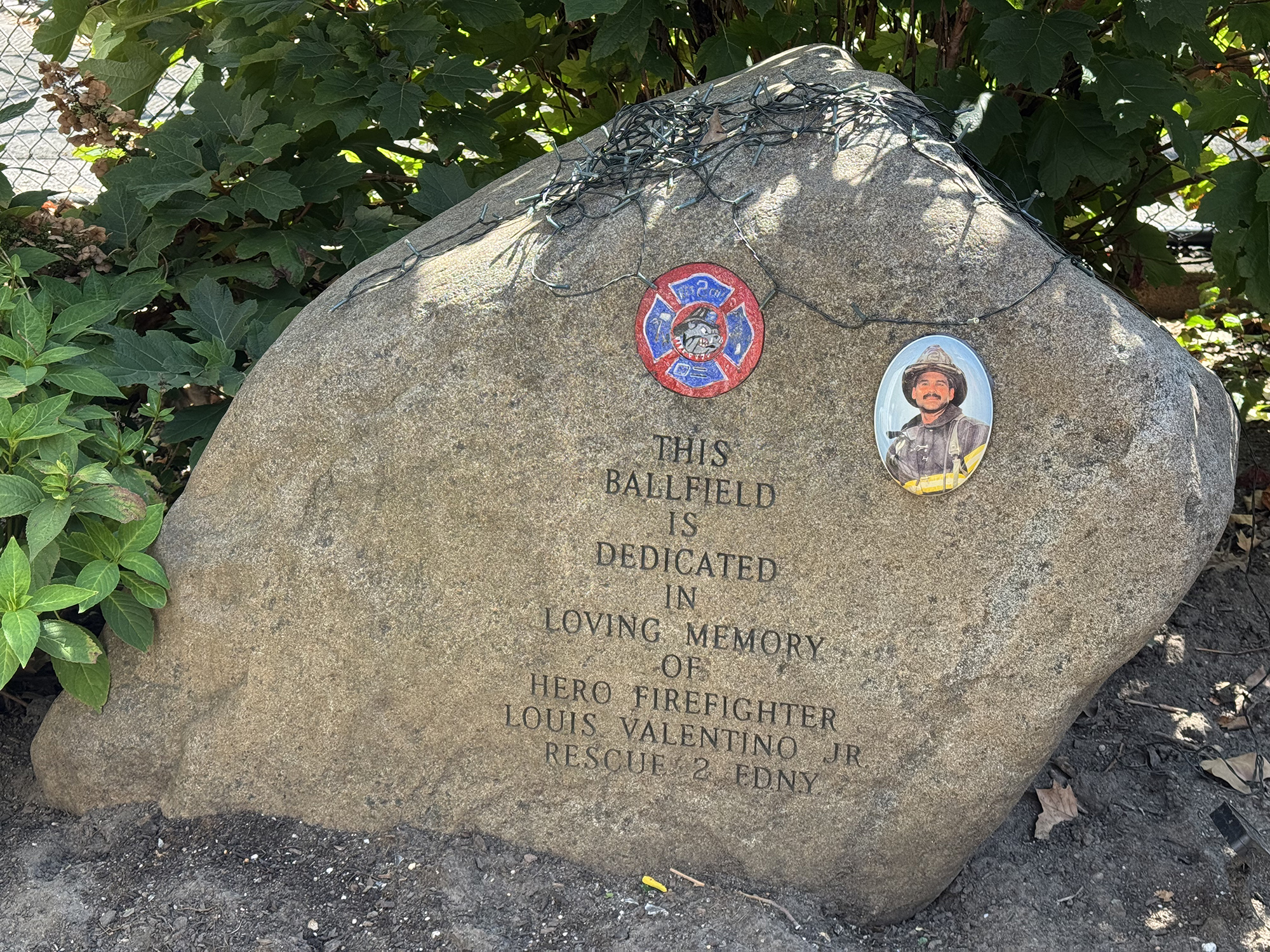
He pointed to the boulder positioned at the corner of the park, just beyond the fence. A colorful bed of flowers surrounded the rock, words were engraved in it, and a photo under glass was mounted on it. Louis Valentino Jr. The photo showed a young, handsome firefighter. The ballpark on that end of Carroll Park is named after him.
“No, I didn’t know him,” I said. “He was clearly loved. Did you know him?”
“Yeah. He was amazing. I used to watch him play here,” he said. “He was one of those players, you know? Nine guys playing the field, but everyone’s eyes were on him. He died trying to save injured fire fighters who were caught inside a fire down in the Flatlands. They were his friends. Roof collapsed on him. Everybody loved Louis.”
“I’m so sorry. That’s awful.”
“Yeah. But if you’re going to document this park, make sure you mention Louis.”
“I will,” I promised. We shook hands and he shuffled off on his way.
Minutes later, before I’d finished the first panorama, a fleet of boys on scooters swarmed around me. They had similar questions, but instead of asking about Louis, they wanted to be in my photo. Only one of them stayed still long enough for me to photograph him, but I was glad to get him, sticking his tongue out at me. It captured the mood of the afternoon perfectly.
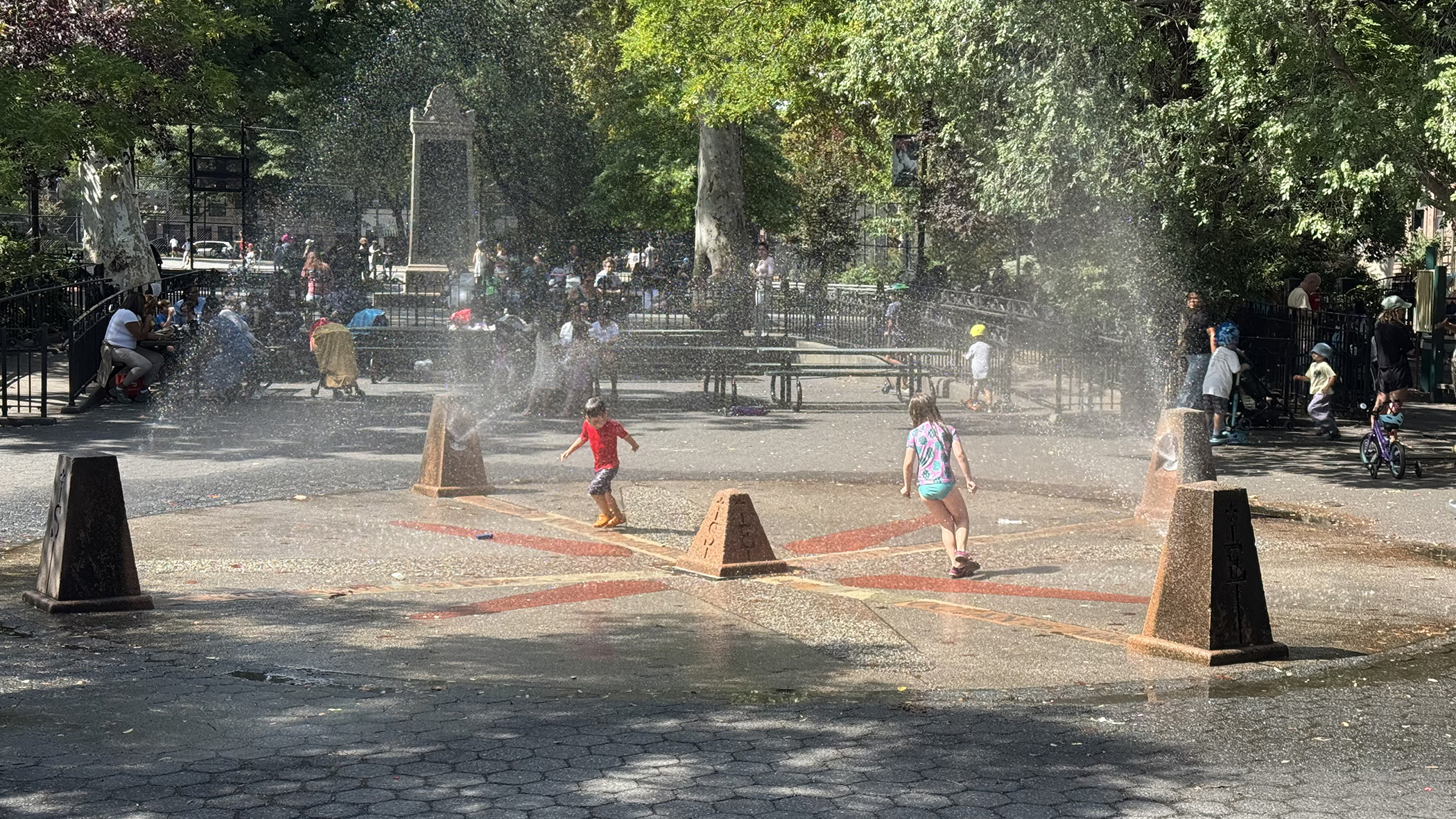
Carroll Park may be less than two acres in size, but it brimmed over with effusive energy and joy on that sunny day. Crammed with kids and their caregivers, it was sometimes tough to find a place where I wouldn’t be in danger of being collided with. Also, while I love having people in my park photos, I try to be respectful and keep a good distance between myself and my subjects. Given the park’s popularity, I found myself often forced to bide my time until the ideal opportunity arrived. Still, this felt like no real inconvenience.
Despite its size, Carroll Park is a remarkable space, and it’s clear many childhoods have treasured the time spent there. When I was done with my shoot, I bought a large ice cream cone, found a bench, and took the unfolding action in with my lens cap on my camera. Laughter, joy, and relaxation can be contagious, and eating my cone, I found myself highly susceptible.
Note: the quotations from Olmsted and Vaux’s reports come from Volume VI of The Papers of Frederick Law Olmsted by John Hopkins Press.
Related